
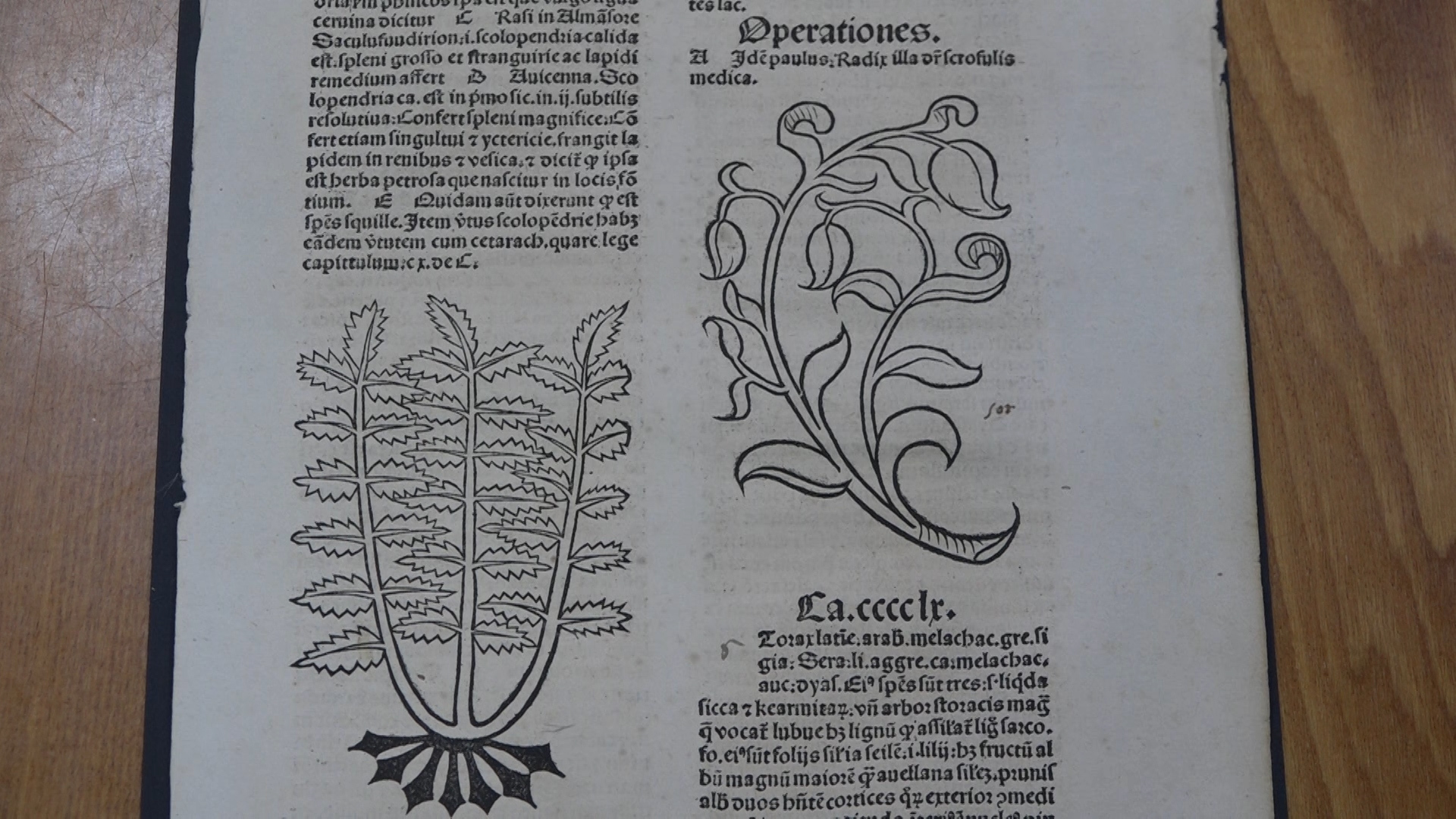
The museum-reserve 'Aleksandrovskaya Sloboda' book collection has a new addition to its series of book engravings. This time it is from the famous Hortus sanitatis, which served as a prototype for the tsar's herbal and healing guide. We should note that the museum's collection also contains a copy of a similar book, published in the mid-17th century. More details can be found in previous news materials.
Explanations are provided by B. N. Morozov, senior researcher at the Institute of Slavic Studies of the Russian Academy of Sciences and member of the Archeographic Commission of the RAS:
The museum's recent acquisition is truly rare and ancient. Before us is a printed leaf from the European edition of 1491 — a kind of encyclopedia of plants with detailed explanations of their medicinal properties. It is one of the first scientific treatises published by followers of the Western pioneer printer Johannes Gutenberg. The museum managed to acquire a page from this expanded edition, which contains a vast amount of information. The text printed on it also appears in the museum's Herbal. Now we have the original of this translation in Latin, set in Gothic type. The plant discussed here is little known. It is called scrofularia (in Russian translated as norichnik — a Eurasian forest-and-wetland species). (It is depicted very picturesquely. Illustrations for these encyclopedias were done by Renaissance-era artists, which adds even more value to the books.) Judging by the text, the plant was used to treat tuberculosis, or 'chakhotka' as it was called in Russia. An interesting observation — in our country there are many herbals published in different centuries that are now called 'folk medicine.' In fact, at their core are translations of European encyclopedias containing recipes from the physicians of Ancient Greece — Dioscorides, Aristotle, the Persian scholar Avicenna, etc.
Note that herbals occupied one of the leading places in the 15th-century book 'repertoire.' The very first herbaria appeared back in the manuscript era. Their problem was that without an accurate depiction of a plant, it was difficult to determine its species based solely on a verbal description. Different names in different languages made the situation even more complicated. The accuracy of the depiction depended on the talent and imagination of the artist, who each time illustrated a new copy of the manuscript anew. The advent of printing decisively changed the situation. Typographic images were identical and reliable. In the preface to one of the first printed botanical editions it is said that the book was compiled for people who could not afford doctors and medicines, so that they could use herbs that are easy to find in gardens, forests and meadows.
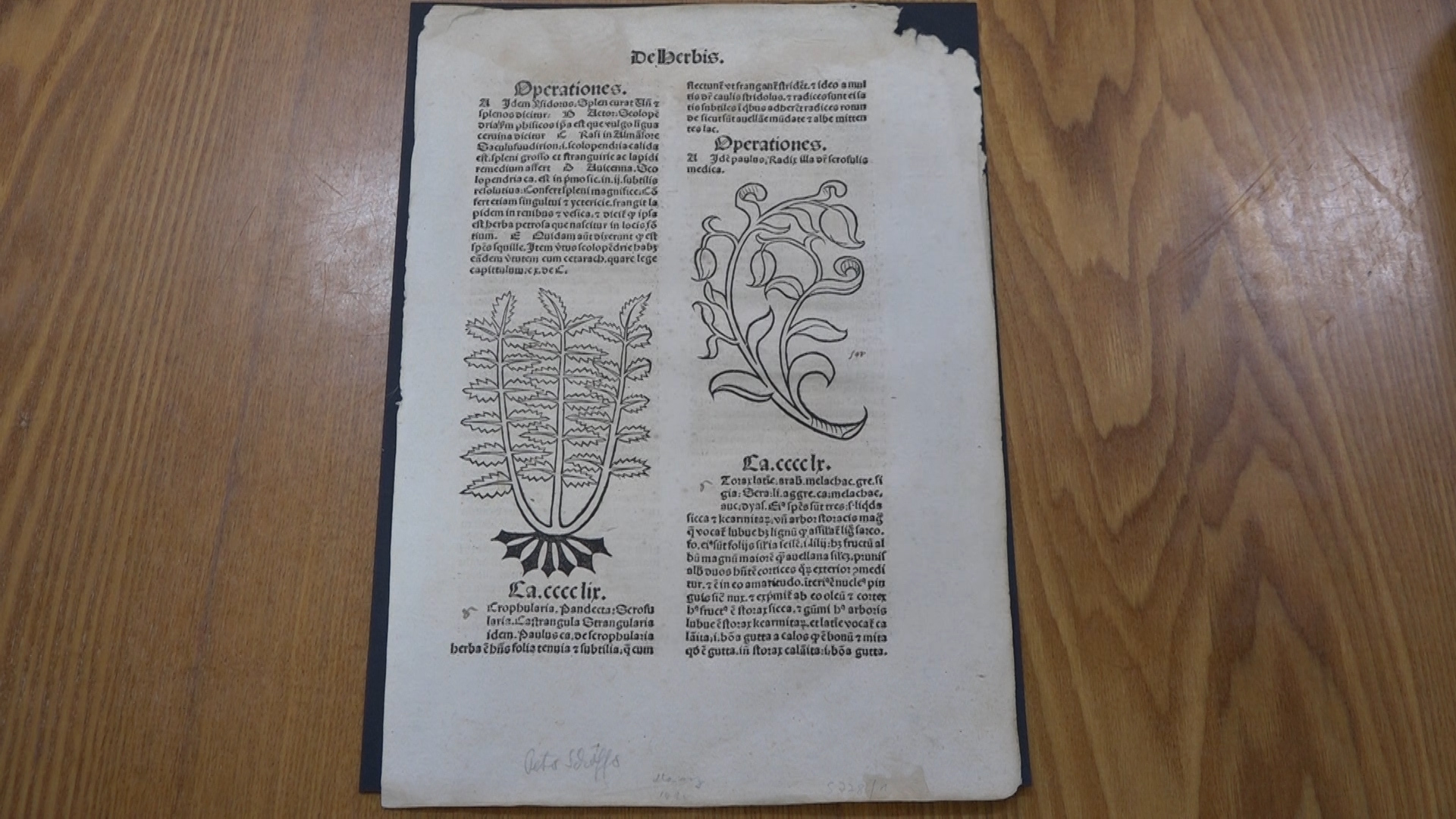
The leaf acquired by the museum has a specific 'address' and authorship. It is from the printed book Hortus sanitatis ('Garden of Health'). Author: Johann Wonnecke von Kaub; printer: Jacob Meydenbach; artist: Erhard Reuwich. Place of creation: Holy Roman Empire, Electorate of Mainz, Mainz. Date: 23 June 1491. Sheet size: 31 x 21 cm. On one side — an illustration of two plants with long stems, leaves, fruits and roots. On the reverse — text in Latin. In the book's preface it is said that the author '...visited Greece and the East to study natural history and, in particular, botany together with another talented artist who made entertaining drawings from life.' The colophon — the final lines of the work, in which the printer evaluated his labor — contains curious information: 'The printer Jacob himself wished that, in this way, the content be conveyed to readers and that those who look on it be given the opportunity to be amused.'
— said Elena Zhestkova, the keeper (curator) of the museum-reserve 'Aleksandrovskaya Sloboda'.
By the way, all books printed before the end of the 15th century are called incunabula (from Latin incunabula — 'cradle', 'beginning'). Editions from this period are very rare because their print runs were only 100–300 copies. Our Russian culture tried to follow foreign novelties, but printing in Russia appeared a century later. And even during the 17th century only three non-church editions were printed here. The museum's copy of the Herbal, copied from earlier 'tsar's counterparts', is a manuscript.
Press service of the museum-reserve 'Aleksandrovskaya Sloboda'


