Very soon, in 2029, the museum will mark an important and genuinely rare date — 150 years since the beginning of archaeological research in this unique area. One and a half centuries of scientific inquiry, discoveries, and painstaking work with cultural layers that preserve traces of the earliest history of humankind. On the eve of the anniversary the museum is beginning a conversation about the scientific journey. The conversation begins with the exhibition Kostenki. The Long Journey of Research.
The opening of the project will take place on March 16 at the Luhansk Art Museum. While preparations are underway, we are sharing with you one of the most expressive and meaningful exhibits of the forthcoming exposition — an archival photograph from 1954.
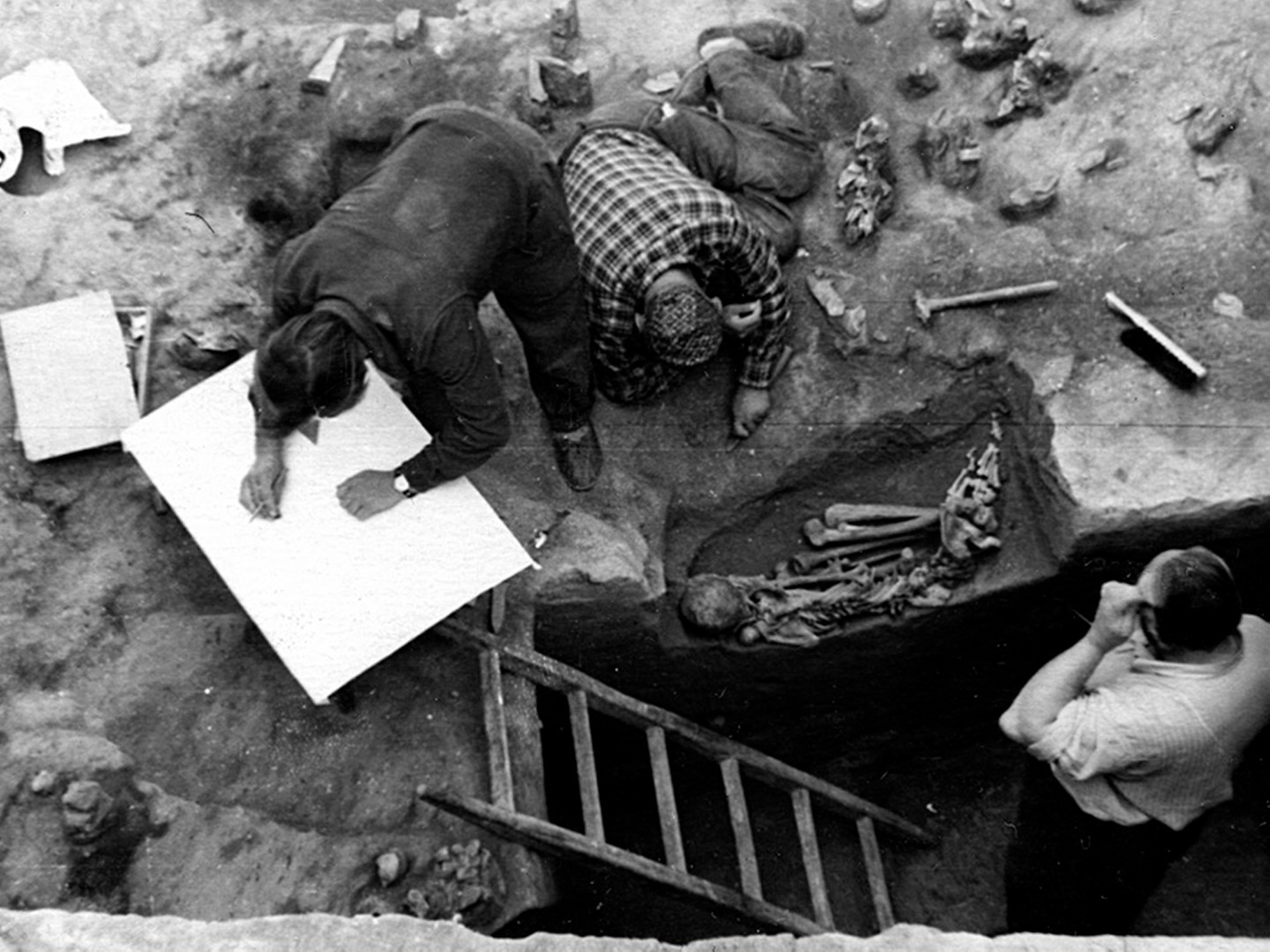
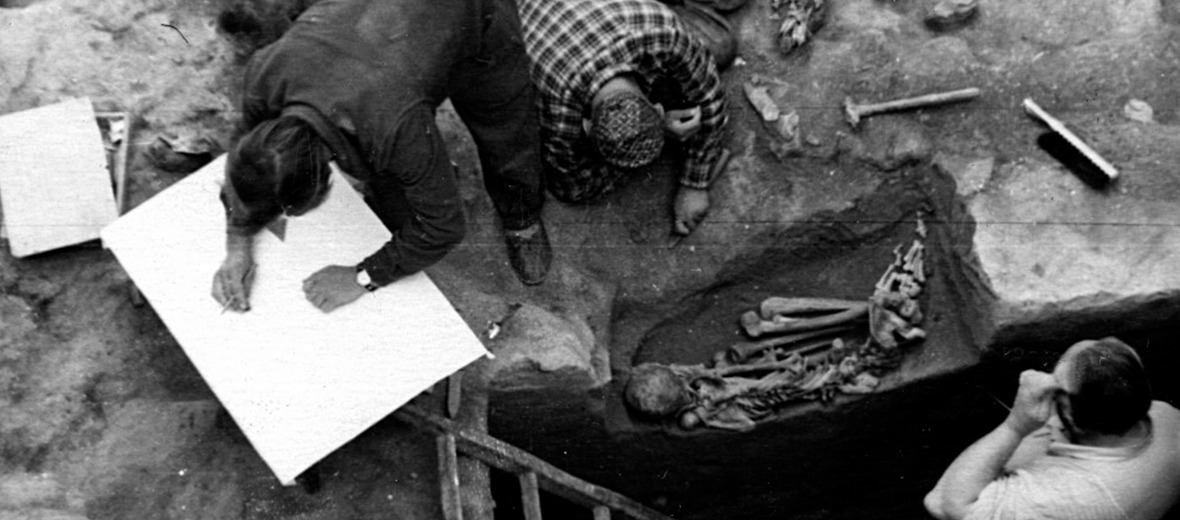
Excavation work clearing the burial at the Kostenki 14 site
The photograph captures the moment of clearing the layer containing a burial at the Kostenki 14 site. This was a time when archaeologists were uncovering Paleolithic burials — exceptionally rare evidence of ancient humans' beliefs about life, death and ritual. In the lower right corner of the photo, with his back to the camera, stands Mikhail Mikhailovich Gerasimov — an anthropologist, archaeologist and legendary facial reconstructer from skulls. He is directing the process of removing the finds, watching every movement closely.
The burial proved to be unique. An almost complete skeleton of an adult male about 160 centimeters tall lay in a crouched position: knees drawn up to the chest, arms crossed, fists clenched, one finger pressed between the jaws. These details allowed researchers to draw important conclusions: the body was probably swaddled or bound before burial, and the bottom of the grave was covered with ochre — a substance that carries particular symbolic meaning in Paleolithic funerary practices.
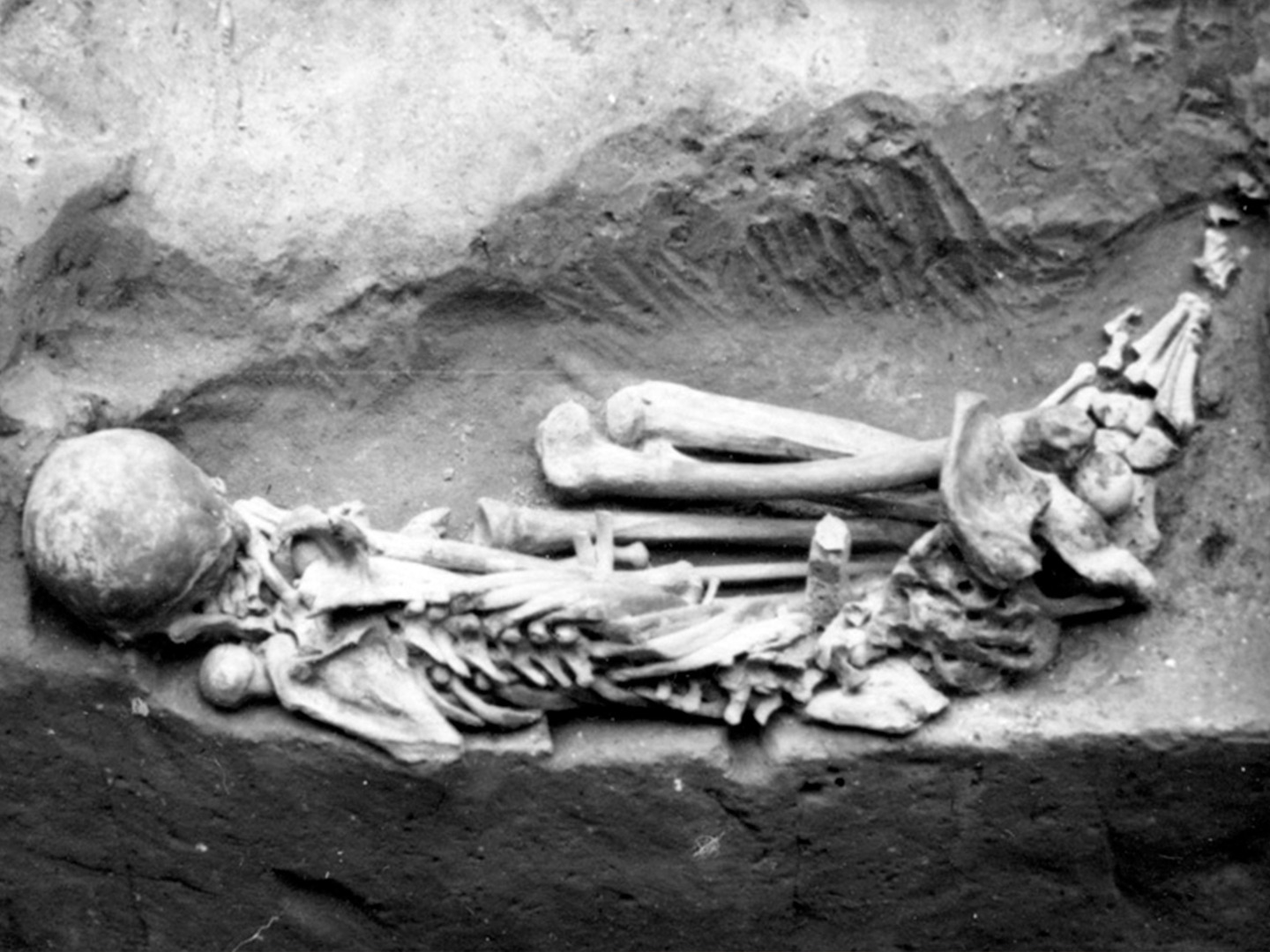
Homo sapiens burial. Kostenki 14 site
The clearing of the burial took exactly one month — from August 19 to September 19, 1954. Slowly, step by step, the archaeologists literally brought a person back from the depth of millennia. All the bones were carefully packed and sent to Moscow. It was there that Mikhail Mikhailovich Gerasimov later produced a reconstruction of this person's appearance — an attempt to give him back a face, a gaze, a human presence.
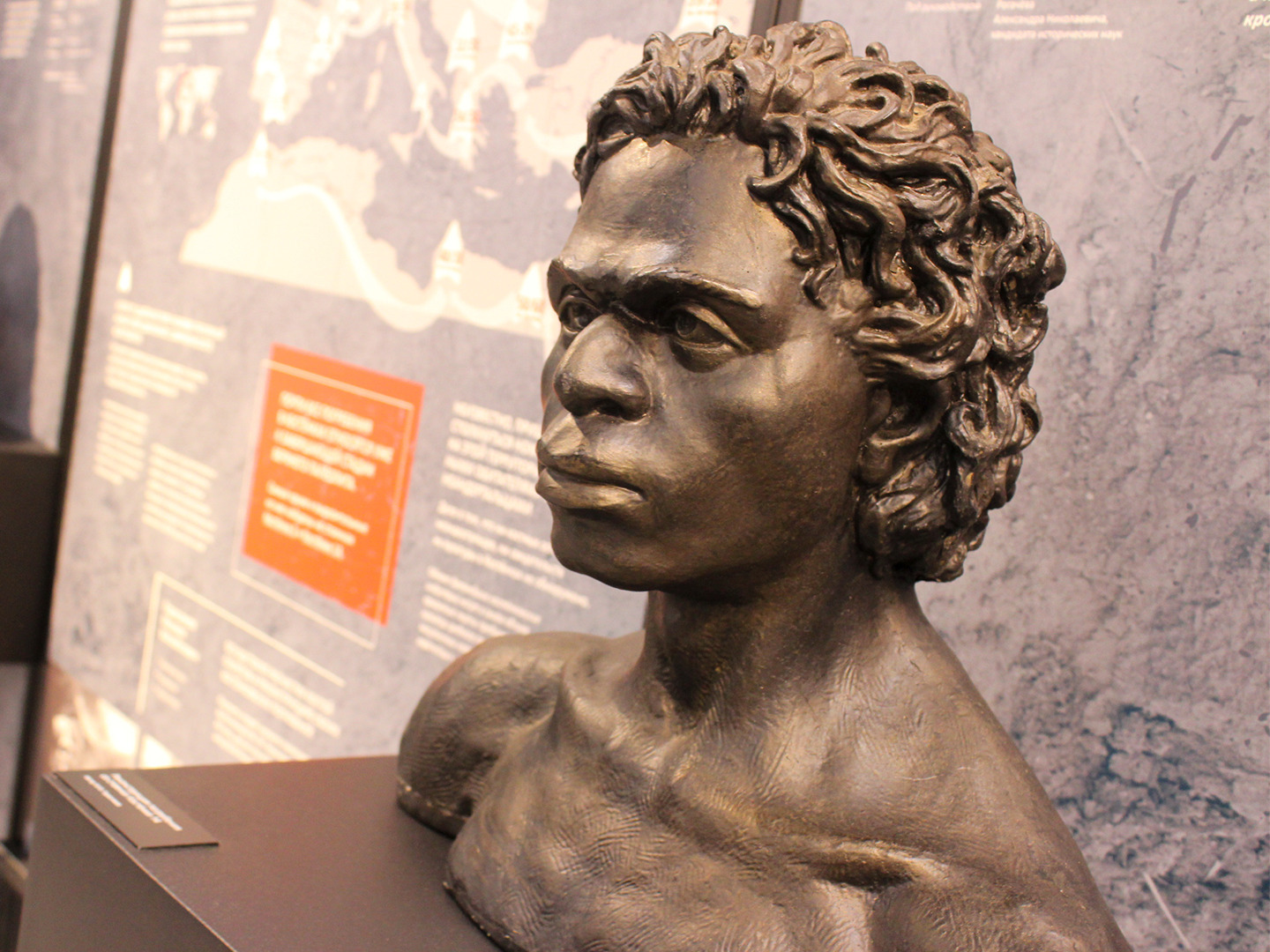
Modern facial reconstruction of the individual from the Kostenki 14 site
Today a copy of that reconstruction is one of the most captivating exhibits of the Kostenki museum-reserve. Alongside a replica of the burial from the Kostenki 14 site, it becomes the central element of most of the museum's exhibition projects. These exhibits travel to cities across Russia, continuing to tell a story not only about the Paleolithic, but also about the very process of scientific discovery.
The exhibition Kostenki. The Long Journey of Research is a story about time, people and science. About how knowledge is born from a carefully removed layer of earth. About how archaeology is always a dialogue. A dialogue between past and present, between people and the memory kept 'underfoot.'