112 years ago this unique house in the Art Nouveau style was built. In the fates of its owners there is likewise neither symmetry nor correctness, only shifts, surprises, breaks and openness to all the winds of a turbulent century.

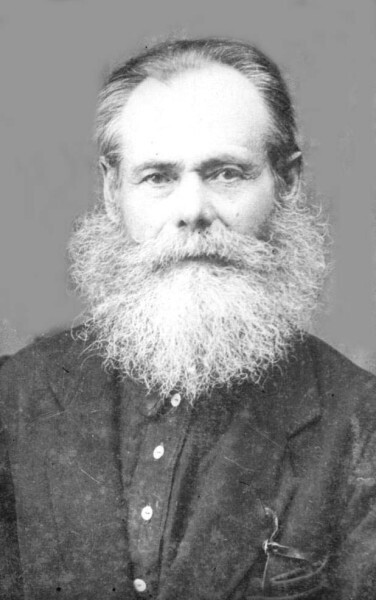
N.V. Smagin, 1913.
In the history of the old merchant town of Sarapul the Smagin family occupies a particularly honorable place. Nikolai Vasilievich Smagin (1850–1918) was a first-guild merchant, commercial councilor, founder of a trading house and a large leather factory, elder of the Pokrov Church, founder of several shelters, a member of the City Duma and City Mayor in 1913–1914. He headed a delegation from Sarapul to the celebrations in Saint Petersburg on the occasion of the 300th anniversary of the House of Romanov.
At the beginning of the 20th century Sarapul was rapidly growing with wealthy buildings in the fashionable Art Nouveau style. Nikolai Vasilievich decided to donate his former house to charitable purposes and commissioned a design for a new mansion from Vyatka provincial architect Ivan Apollonovich Charushin. The Smagin House was built in 1912. Conceived by the author as an architectural fantasy, a synthesis of whimsy and stability, the house astonishes with its appearance! A large two-story stone building with unusual volumes and grand forms, visually “shifted” by its asymmetry, creates the illusion of slow movement of windows, balconies, canopies and the roof. The façade composition is a melody of broken, winding lines. Fragments of stucco ornamentation with plant motifs have been preserved to this day. The main entrance is offset and takes the form of a projecting tower. The roof has an unusual shape (a truncated spire), and above each dormer window there is its own silhouette. The windows of the living floors are of different widths; the dormer windows are of various configurations. There are small windows above the entrance doors, narrow bay-window openings, and one round window — a rose. Also unusual is the stone balcony without a metal grille, with rounded corners and base. Above the balcony is a canopy. On the right side of the house, as its natural extension, are two large verandas on stone supports with a stone balustrade.


Inside the house on the first floor there were capitals and sculptural decorations on the cornice. The floors of the spacious vestibule on the first floor and of the two verandas are laid with a black-and-white tile pattern. The balustrade with handrails and the two-flight staircase to the second floor were originally decorated with chrome grilles. Window frames, high-quality glass and the original bronze window handles have been preserved. In the living room there remains a beautiful and intricate stucco pattern on the ceiling in the corners and a rosette for a chandelier. The first floor housed offices for receiving visitors on commercial matters, a dining room, a kitchen and servants' rooms. On the second floor were spacious living rooms, a sitting room and the owner's study. The mansion was truly “modern” for 1912: it had running water and sewage, electricity and a telephone. A large garden, a yard and various outbuildings (warehouses, barns, cellars, storerooms, a stable, a kitchen, a laundry) adjoined the house.
Nikolai Vasilievich began his business with a small workshop. He married well and for love the daughter of second-guild merchant Vasily Mikhailovich Moschevitin. The couple had seven children. The youngest — Militina — was born in 1898. In Lidiya Budogoskaya’s book The Tale of the Red-Haired Girl she is described as the first pupil of the Sarapul girls' gymnasium, the haughty beauty Nadya Smagina. Yes, in the surviving photographic cards it is evident that Militina was very beautiful. As a teenage girl she moved into the new house built by her father and as a young pregnant widow fled from it.
After finishing gymnasium Militina Smagina went to Moscow to study, but the events of 1917 forced her to return to her native Sarapul. She began working as a teacher in a children's shelter. She met an officer of the 166th Reserve Regiment stationed in Sarapul, Illarion Mikhura, and married him at the beginning of 1918. Her parents blessed the youngest daughter's marriage. The Smagins welcomed their son-in-law into their home. Due to the unrest and change of power, Illarion sent his wife to her relatives in the suburbs and returned to his regiment. He accepted Soviet power, handed over the regimental treasury to its representatives, but this did not save him from arrest. The Sarapul “extraordinary commission” seized the Smagin house. After his arrest Illarion Stepanovich was held in a brick outbuilding of his wife's parents' house. On Easter Day Mikhura and other prisoners were led to Startseva Hill and shot there. From the high slope the bodies fell into the Kama. In L.N. Fedorchenko-Shemyakina’s book Sarapul — a Merchant Town there is a story that a certain fisherman, having caught and gutted a fish, found inside it a gold ring engraved with the name “Militina.” A rare name and a well-known family in the town. The fisherman managed to pass the dreadful find to the one who had on her ring the same engraving “Illarion.” The Smagin family, together with the insurgents, moved east. During the assault on Kazan by the Reds, Nikolai Vasilievich suddenly died, and Militina gave birth to a daughter, Illaria. Retreating with the Whites, the family ended up in Harbin. Mikhail and Lidiya Smagins emigrated to China and later moved to the USA. Pyotr Smagin remained in Harbin for the rest of his life. Vladimir went to Moscow and found work in a shoemaker's workshop. Sister Maria and their mother returned to Sarapul. Militina, with little Illaria in her arms, did not risk traveling back across the country to the ashes of her past life. She worked as a records clerk in the sanitary department administration of the Amur front. In 1923 she married Mikhail Kharlov, a party worker on the Chinese Eastern Railway (KVZhD). A year later their daughter Nadezhda was born; three years later a son, Nikolai. In 1929 Mikhail’s relatives were subjected to dekulakization and he was expelled from the party. The family moved to Kazakhstan. In 1932 Mikhail was arrested for the first time, then released. In 1935 the Kharlovs moved to the Moscow region: the husband worked as a laborer at an oil depot and Militina as a cashier at the State Bank. A younger son, Pyotr, was born into the family. In July 1938 Mikhail Petrovich Kharlov was arrested again, accused of espionage and sentenced to “10 years without the right to correspondence.” Militina did not know that these words meant execution, and she was widowed again. She was dismissed from her job and deprived of housing. She moved with the children to the town of Plyos and survived on temporary work. Illaria served as a nurse in a hospital and after the war graduated from the Izhevsk Medical Institute. Nikolai finished FZU vocational school and served in the army from 1944 to 1951. Afterwards he went to study at the Magadan Geological Exploration College with the secret hope of finding his father: officially he was told that his father was serving time somewhere in the camps. Petya Kharlov at the age of 12 signed on as a sailor on a small vessel and became a seaman. In her later years Militina Nikolaevna lived with her youngest son in the city of Rybnitsa and died in 1976.


The Smagin House was successively occupied by the Cheka, the OGPU, the NKVD, the KGB, the city police department and now the traffic police (GIBDD). Naturally, internal reconfiguration of the building took place. New doors were cut through and the old ones sealed. Large rooms and halls were divided into separate small service offices. The floors of inlaid wooden parquet, laid out in a pattern, are covered with linoleum. An old mirror of the former owners with faceted edges in a wooden frame has been preserved to this day.