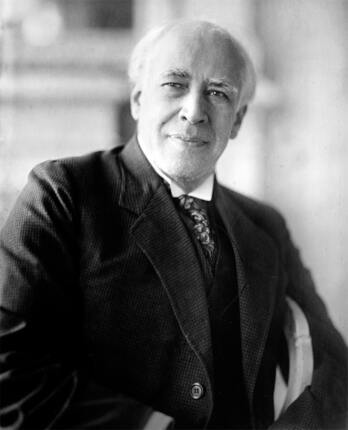
Konstantin Sergeyevich Stanislavsky (real surname – Alekseev) was a Russian actor and director, and a theorist of stagecraft. He was born in Moscow into a large family of the industrialist Sergey Alekseev, who was related to Savva Mamontov and the Tretyakov brothers. From childhood he showed an interest in the theatre, but at first he regarded the theatre only as a pleasant hobby. When he grew up, Konstantin was expected to take over his father's business and run a large factory.
Stanislavsky began his theatrical activity on the amateur stage. In 1888 he organized the Moscow Society of Art and Literature, where he gained professional experience as an actor and director. In 1898 Stanislavsky became one of the founders of the Moscow Art Theatre, where he combined the roles of actor, director, and chief director. Stanislavsky staged a number of legendary productions: "The Seagull" (1898), "Uncle Vanya" (1899), "Three Sisters" (1901), "The Lower Depths" (1902), "The Cherry Orchard" (1904), "Woe from Wit" (1906) and many others. In these productions he brilliantly performed the leading roles. In the 1900–1910s Konstantin Stanislavsky developed a method of acting technique and a theory of stagecraft that became popular in the global acting community — the Stanislavsky system. The main goal of the system is to achieve complete psychological truthfulness in performance. Konstantin Stanislavsky was the first person to be awarded the title "People's Artist of the USSR" for his contribution to the development of theatrical art.
In 1928, during a performance at the theatre, Stanislavsky suffered a heart attack. For ten years he bravely fought the illness and continued to work despite severe pain. Konstantin Sergeyevich passed away on August 7, 1938, and was buried at the Novodevichy Cemetery.
A service for finding museums across Russia, on a map, as a list, and in curated collections
Sign up
You have successfully registered, a confirmation email has been sent to the email address you provided.
Продолжая использовать наш сайт, Вы соглашаетесь на обработку файлов cookie. Data is processed to provide our services and improve the quality of our website and services.