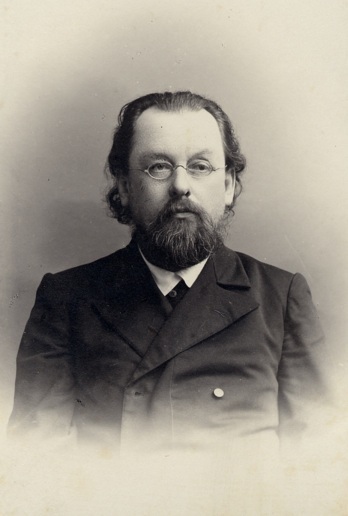
Konstantin Eduardovich Tsiolkovsky – a Russian and Soviet self-taught scientist who developed theoretical issues of astronautics. The founder of modern astronautics was born in the village of Izhevskoye in the Ryazan Governorate into the family of a forester. From 1868 he lived with his parents in Vyatka (now Kirov), and attended gymnasium. Childhood scarlet fever led to an almost complete loss of hearing and interrupted his formal education. From the age of fourteen Tsiolkovsky pursued self-education.
From 1873 to 1876 he lived in Moscow, where he independently studied chemistry and the physical and mathematical sciences using books from the Rumyantsev Museum library. In 1879 Tsiolkovsky successfully passed the examination for the title of public school teacher and taught mathematics and physics at schools in Borovsk and Kaluga until 1921. His scientific activity began with the work 'Theory of Gases' (1880–1881). In the same years he wrote and published 'Mechanics of the Animal Organism', which gained recognition from leading scientists and secured Tsiolkovsky membership in the Russian Physico-Chemical Society.
In 1883 he produced the work 'Free Space', in which he first set out the principles of the reaction engine. From 1884 Tsiolkovsky worked on the development of an airship and a 'streamlined' aeroplane, and from 1886 on the theoretical justification of rockets for interplanetary flights. In 1932 the scientist developed a theory of flight for jet aircraft in the stratosphere and schemes for supersonic flying machines. Konstantin Eduardovich Tsiolkovsky died on 19 September 1935 and was buried in Kaluga, in the Zagorodny Garden.
A service for finding museums across Russia, on a map, as a list, and in curated collections
Sign up
You have successfully registered, a confirmation email has been sent to the email address you provided.
Продолжая использовать наш сайт, Вы соглашаетесь на обработку файлов cookie. Data is processed to provide our services and improve the quality of our website and services.