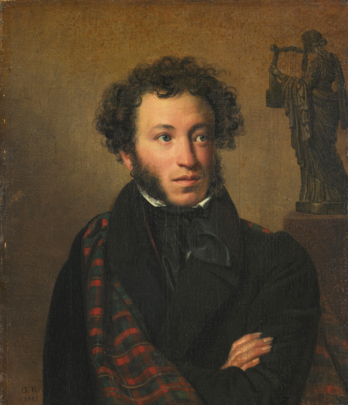
Alexander Pushkin was a Russian poet, playwright and prose writer who laid the foundations of the Russian realist movement, a literary critic and theorist, historian, publicist, journalist, editor and publisher. He was born in Moscow into an impoverished noble family. Poets, artists and musicians often gathered at the Pushkins' home. French culture and an excellent education had a significant influence on the upbringing of the children. Pushkin was not particularly diligent at school, but from an early age showed a passion for literature: from the age of seven he composed small comedies in French, imitating Molière, and wrote fables and poems.
At twelve, Pushkin entered the elite Tsarskoye Selo Lyceum, where he found his closest friends: Ivan Pushchin, Anton Delvig and Wilhelm Küchelbecker. While studying at the Lyceum, Pushkin continued to read widely and to write in French, and during the winter transfer exam the fifteen-year-old poet read his poem 'Memories in Tsarskoye Selo', astonishing Gavriil Derzhavin. After graduating from the Lyceum, Pushkin joined the literary-theatrical society 'The Green Lamp' at the Decembrist 'Union of Welfare'. Its members promoted liberal ideas. Pushkin's works 'Liberty', 'To Chaadaev' and 'The Village' incurred the wrath of Alexander I, who ordered the poet to be exiled to Siberia or to the Solovetsky Monastery, but thanks to Karamzin's intercession Pushkin was reassigned to serve in the South.
During this period were born the works 'The Prisoner of the Caucasus', 'The Gabrieliad', 'The Robber Brothers', 'The Fountain of Bakhchisarai', 'The Song of the Wise Oleg', and work began on the verse novel 'Eugene Onegin'. For atheist statements in a letter to Küchelbecker, Pushkin was exiled to Mikhaylovskoye, where he lived in confinement, conversed with his nurse Arina Rodionovna and wrote the tragedy 'Boris Godunov'. Nicholas I, who came to power, crushed the Decembrists, released Pushkin from exile, guaranteed his patronage and offered him the position of his personal censor. The emperor hoped that Pushkin would become a court poet, but he continued to write liberal poems supporting revolutionary ideas. Once more strict surveillance was imposed on Pushkin; he was forbidden to travel freely around the country and to read his works publicly.
At the same time the poet met Natalya Goncharova and proposed to her, but was refused by the bride's parents because of her youth. To forget, he went to the Caucasus, where he created a cycle of poems: 'The Caucasus', 'On the Hills of Georgia the Night's Mist Lies...', 'The Landslide', 'Delibash' and 'The Monastery on Kazbek'. A year later the poet returned to Moscow and proposed to Goncharova again — this time the marriage was blessed. Since Pushkin had no property, his father granted him part of the family estate in Boldino in the Nizhny Novgorod region; the poet went there to settle legal matters but could not return to the capital because of a cholera epidemic.
The autumn he spent in Boldino is the most productive period in the poet's creative biography. It was here that 'Eugene Onegin' was completed, 'Tales of the Late Ivan Petrovich Belkin', 'The Story of the Village of Goryukhino', 'Little Tragedies', the drama 'Rusalka', the poem 'The Little House in Kolomna' and numerous poems were written. After the wedding the poet gathered material for a work dedicated to Yemelyan Pugachev, and in the second Boldino autumn he wrote 'The Bronze Horseman', 'Angelo', 'The Queen of Spades', 'The Tale of the Fisherman and the Fish', 'The Tale of the Dead Princess and the Seven Knights'. In his later years he gravitated toward the realist trend in literature, wrote about social inequality and did not find understanding among his contemporaries. He died tragically as a result of a duel with Georges d'Anthès, who had besmirched Natalya Pushkina's reputation.
A service for finding museums across Russia, on a map, as a list, and in curated collections
Sign up
You have successfully registered, a confirmation email has been sent to the email address you provided.
Продолжая использовать наш сайт, Вы соглашаетесь на обработку файлов cookie. Data is processed to provide our services and improve the quality of our website and services.