Sign up
You have successfully registered, a confirmation email has been sent to the email address you provided.

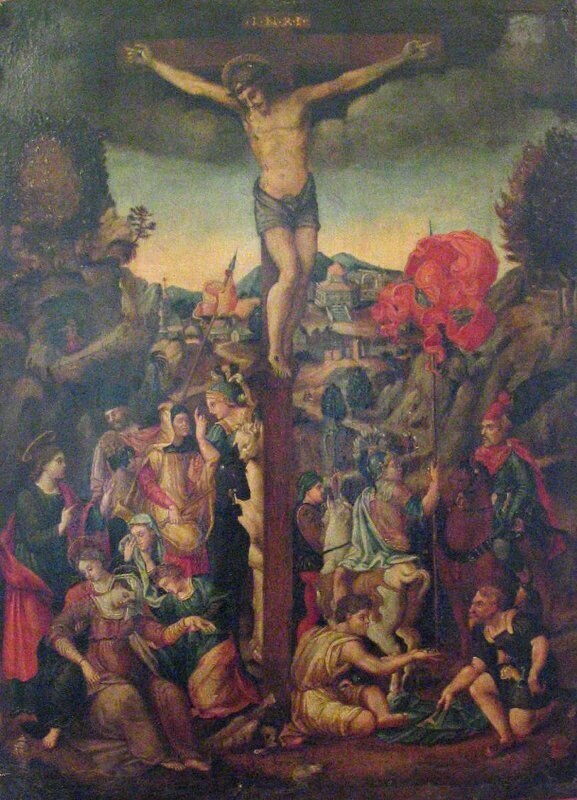
The earliest painting in the collection of the New Jerusalem Museum is a "Crucifixion" by an unknown Netherlandish artist, painted in oil on wood in the first third of the 16th century. The scene is set on Golgotha during the eclipse: the cross, beneath dark rays, divides the picture into two almost symmetrical halves.
On the left, women support the fainting Virgin Mary; behind her stands the full-length figure of Mary Magdalene, with a vessel of chrism at her feet. Among the Roman soldiers the centurion Longinus stands out. In the right foreground, soldiers cast dice for Christ's garments, and behind them are soldiers on foot and on horseback. In the distance on the left, a small figure of Saint Jerome can be seen in a cave, while the centre opens onto a view of Jerusalem, surrounded by a fortress wall, with an octagonal building in the middle.
The composition is built on a combination of pure reds, yellows, greens and browns. In the museum's collection it opens the small section of Western European painting.
