Sign up
You have successfully registered, a confirmation email has been sent to the email address you provided.

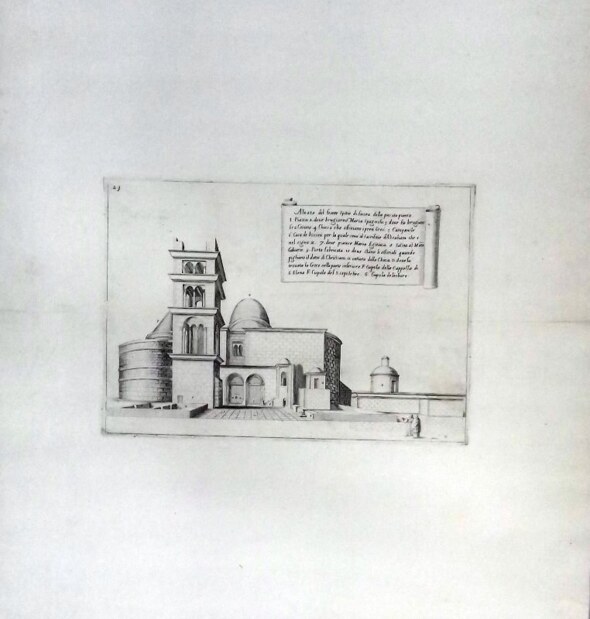
This early 17th-century print is linked to the very history of New Jerusalem. Italian engravings of the Church of the Holy Sepulchre are the earliest works in the museum's graphic art collection. The authors of this sheet include the French engraver Jacques Callot (1592–1635), one of the most important masters of etching, and the Italian friar Bernardino Amico, known for his depictions of the holy sites of Palestine.
Patriarch Nikon conceived New Jerusalem on the Istra River near Moscow as a recreation of the principal holy sites of the Holy Land. Striving for accuracy, he used Bernardino Amico's drawings of the Church of the Holy Sepulchre, the Bethlehem basilica and other churches of Palestine.
The sheet shows the south facade of the Church of the Holy Sepulchre: from left to right, the rotunda, the bell tower, the cross-domed section and the underground church. At the lower right, small figures of Catholic monks are talking, and at the top a scroll carries a key in Italian, with places in the image marked by numbers and Latin letters. The print is executed in engraving and etching on watermarked paper and dates from 1609–1620.
