Sign up
You have successfully registered, a confirmation email has been sent to the email address you provided.

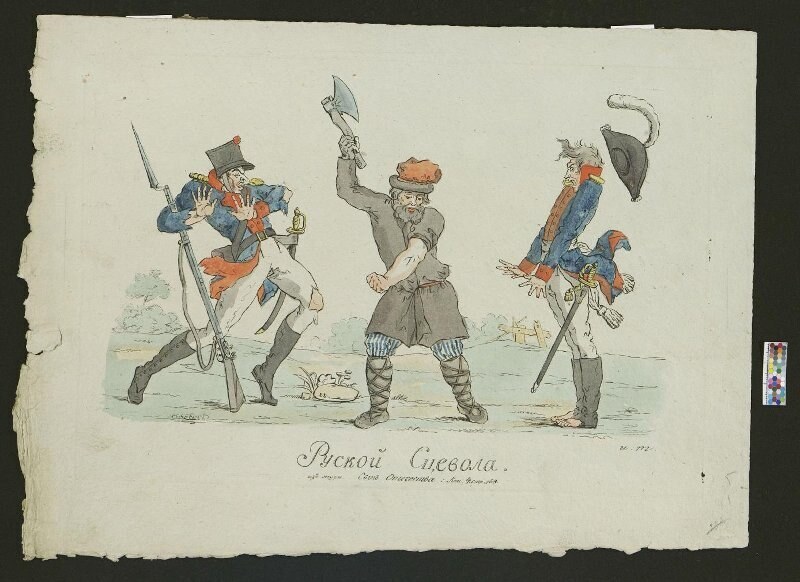
This sheet by Ivan Terebenev (1780–1815) is one of the anti-Napoleonic caricatures of 1812. In the watercolour-tinted etching a bearded peasant raises an axe over his own arm, while two French soldiers recoil in horror. The caption beneath the image reads "The Russian Scaevola".
The subject goes back to a story printed in the journal "Son of the Fatherland", published from October 1812. According to the note, the French branded a peasant who had fallen into their hands as a new soldier of Napoleon, and he cut off his branded hand with an axe. The journal compared him to the Roman Gaius Mucius Scaevola, who, according to legend, burned his right hand in a fire before the Etruscan leader Porsena. Whether such a peasant really existed is unknown.
Terebenev became famous precisely for his engraved caricatures of Napoleon and his army; his sheets combined official propaganda, British caricature and the Russian popular print, the lubok. The art historian Dmitry Rovinsky described five versions of the "Russian Scaevola" by four artists, and Terebenev's was repeated in the 1815 alphabet book "A Gift to Children in Memory of the Events of 1812".
