Sign up
You have successfully registered, a confirmation email has been sent to the email address you provided.

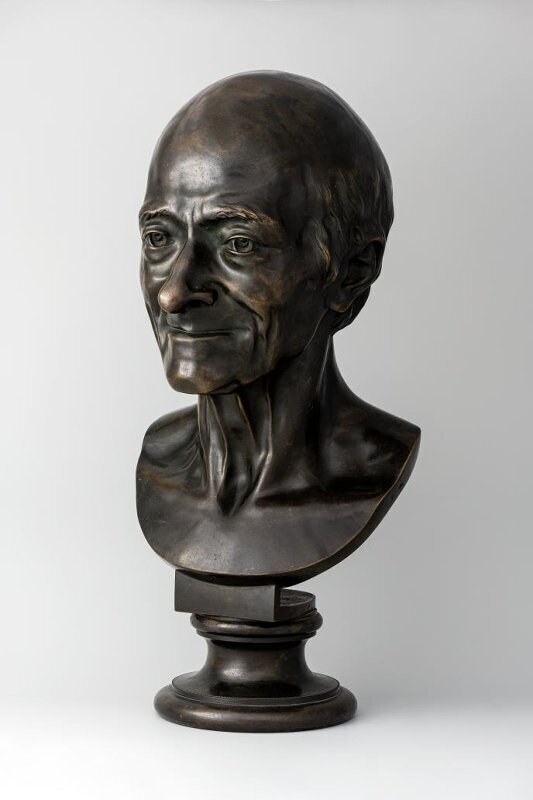
This bronze bust of Voltaire by Jean-Antoine Houdon was made in France in 1778, the year of the philosopher's death. Houdon worked from life. Voltaire died on 30 May 1778, and the next day the sculptor took plaster casts of his face and hands. The work from life and the casts became the basis for several portraits of the philosopher.
Voltaire (born François-Marie Arouet, 1694–1778) was a French Enlightenment philosopher, historian, poet and essayist, and a member of the Académie française from 1746. From 1763 Catherine II corresponded with him: the empress called herself the philosopher's pupil, while Voltaire admired her and helped strengthen her standing in Europe. After his death Catherine acquired Voltaire's library. Under the influence of his ideas, Voltairianism, a political and religious freethinking, took shape in Russia in the 18th and the first half of the 19th century.
Houdon (1741–1828) was a master of the psychological portrait and the author of busts of Diderot, Benjamin Franklin, George Washington and Catherine II herself. Busts of Voltaire kept leaving his workshop until the end of the sculptor's life: academies, libraries, theatres and learned societies throughout Europe and America wanted to have one.
