Sign up
You have successfully registered, a confirmation email has been sent to the email address you provided.

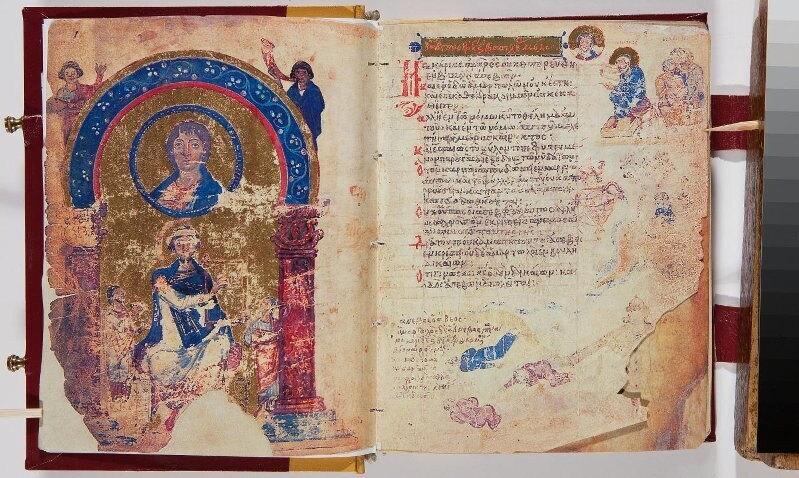
The Chludov Psalter is a Byzantine manuscript of the mid-9th century, created in Constantinople shortly after the end of the Iconoclast period. It is a so-called marginal psalter: more than two hundred miniatures are placed in the wide margins next to the text of the Psalms. It is one of three surviving illustrated Byzantine psalters of the 9th century, and in 2025 UNESCO included it in the Memory of the World Register.
Many of the miniatures are polemical and respond to the recent struggle over icons. In one of them a soldier offers the crucified Christ a sponge with vinegar, while below the Iconoclast John the Grammarian daubs over an image of Christ: the opponents of icons are thus likened to Christ’s tormentors.
The museum dates the manuscript to the 9th, 12th and 14th centuries: later it was renovated, the faded text being rewritten over the old one and the miniatures covered with a new layer of paint. In 2017–2020 specialists of the Historical Museum and the Space Research Institute of the Russian Academy of Sciences used multispectral imaging to reveal the original images and preparatory drawings. The manuscript is written in uncial script on parchment. In the mid-19th century it was taken from Mount Athos, in the late 1860s it came to the Moscow collector Alexei Khludov, after whom it is named, and after 1917 it entered the Historical Museum.
