Sign up
You have successfully registered, a confirmation email has been sent to the email address you provided.

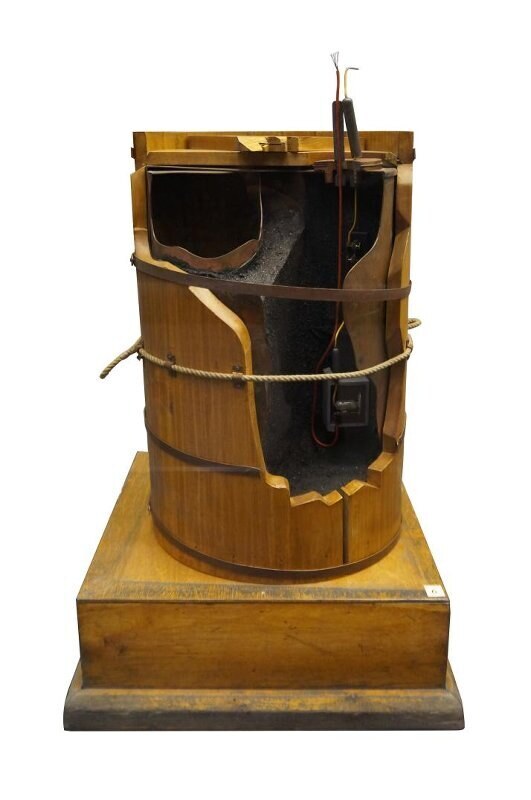
This cutaway model shows how a mid-19th-century naval mine with a galvanic fuse was built. It was made in Leningrad in 1949 from the original drawings of Academician Boris Jacobi, which are kept in the archive of the Russian Academy of Sciences.
Boris Semyonovich Jacobi (1801–1874) was a German and Russian physicist, a native of Potsdam, who discovered galvanoplasty (electrotyping) and created the world's first electric motor with a rotating working shaft. From 1839 he was a member of the Committee on Naval Mines; under his direction several designs of mines and fuzes were developed, among them the galvanic contact mine. In the Crimean War this weapon was used in combat for the first time: Russian sailors laid mines in large numbers on the approaches to Kronstadt, and on 8 (20) July 1855 four British steamers struck them one after another and were damaged, after which the enemy squadron hastily withdrew to sea.
A copper cylinder is placed inside a wooden barrel. The cutaway reveals an air cylinder, the meal powder filling the rest of the space, and the galvanic fuse with wires and a connecting device that set off the explosion. The barrel is bound with copper hoops, slung with rope and set in a four-sided wooden frame.
