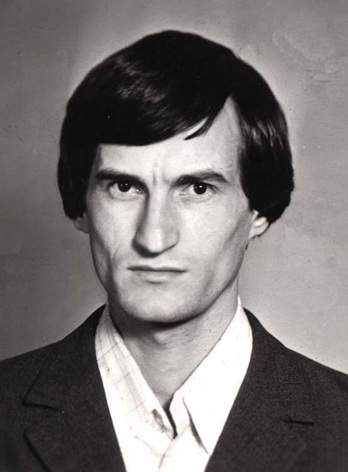
Vladimir Ivanovich Romashkin (pseudonym Yovlan Olo) – a figure of the Moksha, Karatai, Teryukhan and Erzya cultural revival of the late 20th century, folklorist, musician and documentary filmmaker. He was born on September 6, 1951. In 1975 he graduated from the conducting and choral department of the Saransk Music School named after L. P. Kiryukov, in 1980 — from the conducting and choral faculty of the Kazan Conservatory, in 1986 — from the postgraduate program at MNIYALIЭ (folklore and arts sector). From 1980 to 1989 he was a research fellow in the folklore and arts sector of the Mordovian Research Institute of Language, Literature and History.
In 1986 his monograph «On Some Features of the Traditional Song Art of the Mordva-Karatai» was published, in which he described the folklore of the Karatai villages in the Tatar ASSR. Later Vladimir Romashkin worked as a screenwriter and filmmaker; documentary films "Karatai" and "Istoki" were produced with his participation. Since 1990 he taught musical subjects at the Republican School of Culture in Saransk. Vladimir Romashkin's best-known work is the creation of the ethnomusic ensemble "Torama", whose repertoire included Erzya, Moksha and Karatai songs. In his later years, in contact with the Russian reconstructionist movement, Vladimir Romashkin headed the youth movement "Od Viy" (New Force).
Some awards: Honored Worker of Culture of the Republic of Mordovia; Knight of the Order of the Cross of Saint Maria for a major contribution to the development and dissemination of Finno-Ugric culture worldwide (March 7, 2001); laureate of the A. P. Ryabov Prize for his contribution to the preservation and development of the Erzya language (2002). Vladimir Ivanovich Romashkin passed away on August 29, 2002. On September 6, 2006 (on the 55th anniversary of the musician) the house-museum "Ethno-Kudo" named after V. I. Romashkin was opened in the village of Podlesnaya Tavla, Kochkurovsky District, Mordovia.
A service for finding museums across Russia, on a map, as a list, and in curated collections
Sign up
You have successfully registered, a confirmation email has been sent to the email address you provided.
Продолжая использовать наш сайт, Вы соглашаетесь на обработку файлов cookie. Data is processed to provide our services and improve the quality of our website and services.