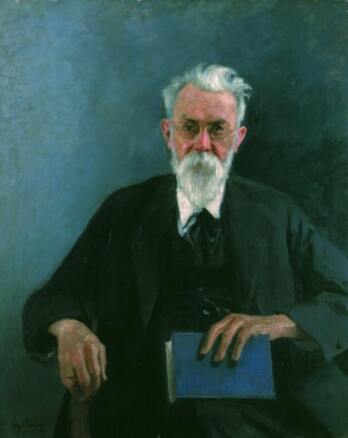
Vladimir Ivanovich Vernadsky – a Russian and Soviet natural scientist, thinker and public figure of the late 19th century and the first half of the 20th century. He was born on March 12, 1863 in Saint Petersburg into a noble family. His father, Ivan Vasilievich Vernadsky, was an economist and professor, and his mother, Maria Nikolaevna Vernadskaya, was the first woman political economist in Russia. Vernadsky was educated at the gymnasiums of Kharkov and Saint Petersburg (1873–1880), and then at the natural science department of the Faculty of Physics and Mathematics of Saint Petersburg University (1881–1885).
Vernadsky is the founder of geochemistry, biogeochemistry, radiogeology and other Earth sciences. He founded numerous scientific schools, was an academician of the USSR Academy of Sciences and the first president of the Academy of Sciences of Ukraine. From 1898 to 1911 he taught at Moscow University as a professor, and in 1914 he headed the Geological and Mineralogical Museum of the Petersburg Academy of Sciences. Vernadsky was also one of the organizers and the chairman of the Commission for the Study of the Natural Productive Forces of Russia (KEPS). From 1922 to 1939 Vernadsky led the State Radium Institute which he had established.
Central to his scientific and philosophical work was the development of the doctrine of the biosphere, living matter and the evolution of the biosphere into the noosphere. His ideas about the interconnection of nature and society significantly influenced the formation of modern ecological consciousness. Vladimir Ivanovich Vernadsky died on January 6, 1945 in Moscow.
A service for finding museums across Russia, on a map, as a list, and in curated collections
Sign up
You have successfully registered, a confirmation email has been sent to the email address you provided.
Продолжая использовать наш сайт, Вы соглашаетесь на обработку файлов cookie. Data is processed to provide our services and improve the quality of our website and services.