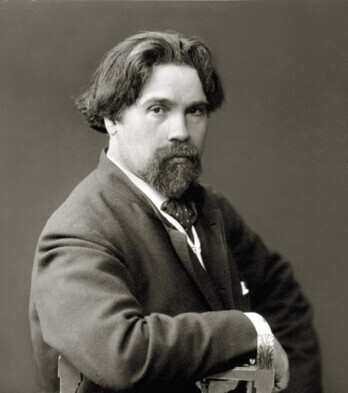
Vasily Ivanovich Surikov – a Russian painter, a master of large-scale historical canvases. One of the leading representatives of the realist direction in Russian art. He was born on 12 (24) January 1848 in Krasnoyarsk into a Cossack family.
The early loss of his father plunged the family into poverty and his mother had to rent out the second floor of the family house. Vasily received his first painting lessons from N. V. Grebnev, who taught drawing at the Krasnoyarsk district school. The earliest surviving work by Surikov is the watercolor "Rafts on the Yenisei", painted by him at the age of 14. After finishing school, Vasily's mother could not afford his further education, so he was forced to take a job as a clerk in the provincial administration. However, Governor P. Zamyatin found a patron, P. Kuznetsov, who financed Surikov's studies at the St. Petersburg Academy of Arts.
At the Academy Vasily learned the fundamentals of painting under the guidance of Pavel Petrovich Chistyakov and quickly became one of his best students. He repeatedly received cash awards and medals for his works. The first large-scale work that brought Surikov recognition was the painting "View of the Monument to Peter I on Senate Square in St. Petersburg." He sold it to his patron P. Kuznetsov. One of Surikov's most famous works — "Morning of the Streltsy Execution" — was created over about three years and opened the doors to the world of great art. Surikov became a member of the Association of Traveling Art Exhibitions.
In 1881 Surikov began working on his equally famous painting "Boyarynya Morozova." Other important canvases by Surikov include "Taking the Snow Town", "Suvorov's Crossing of the Alps" and "Stepan Razin." On 6 March 1916, at the age of 68, the great artist died of ischemic heart disease.
A service for finding museums across Russia, on a map, as a list, and in curated collections
Sign up
You have successfully registered, a confirmation email has been sent to the email address you provided.
Продолжая использовать наш сайт, Вы соглашаетесь на обработку файлов cookie. Data is processed to provide our services and improve the quality of our website and services.