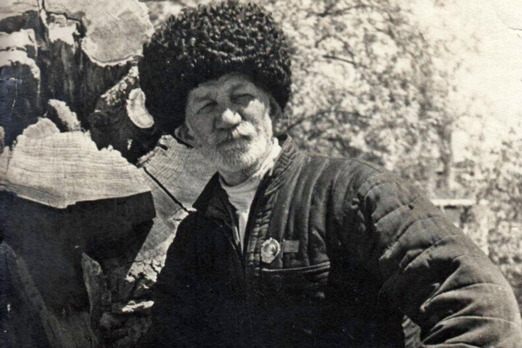
Suleyman Stalsky (real surname – Gasanbekov) was a Lezgin poet, the founder of Lezgin, Dagestani and pre-Soviet poetry, one of the greatest Dagestani poets of the 20th century, and People's Poet of the Dagestan ASSR (1934). He was born on 18 May 1869 in the village of Ashaga-Stal. His childhood was difficult. The early loss of his mother and the subsequent death of his father left him defenseless before his stepmother, who deprived him of his inheritance and gave it to her own children. From the age of thirteen Stalsky was forced to earn his living on his own. He worked at the Baku oilfields, on the railway in Samarkand, dug ground during the construction of a bridge across the Amu Darya, and worked as a farmhand for well-to-do people.
Suleyman Stalsky began his poetic activity in his youth. His poems protested against injustice and social ills. His first works were written in Azerbaijani. In the early 1930s Stalsky's poems began to be published in republican periodicals in Lezgin, Russian and other languages of Dagestan. In 1934 the first collection of his poems in his native language was published under the title 'Selected Poems'. In the same year Stalsky was awarded the title People's Poet of Dagestan. He became a delegate to the First All-Union Congress of Writers in Moscow. After Stalsky's speech, Maxim Gorky called him 'the Homer of the 20th century'. Suleyman Stalsky passed away on 23 November 1937 and was buried in Makhachkala, on the boulevard that now bears his name.
A service for finding museums across Russia, on a map, as a list, and in curated collections
Sign up
You have successfully registered, a confirmation email has been sent to the email address you provided.
Продолжая использовать наш сайт, Вы соглашаетесь на обработку файлов cookie. Data is processed to provide our services and improve the quality of our website and services.