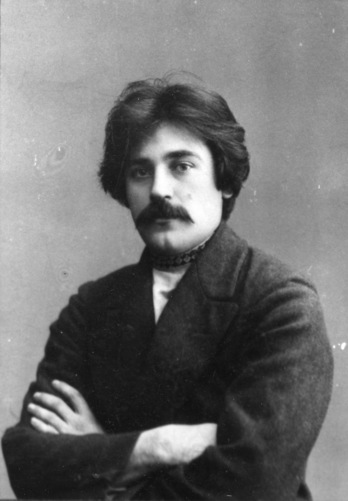
Sergey Antonovich Klychkov was a Russian and Soviet poet, prose writer and translator, and a literary critic. He was born in 1889 in the village of Dubrovki in the Tver Governorate into the family of an Old Believer cobbler. He was educated at a zemstvo school and a real school in Moscow, and also attended Moscow University, but did not complete it due to financial difficulties. With the support of M. I. Chaikovsky, Klychkov was able to visit Italy.
In 1909 Klychkov became acquainted with the younger symbolist writers, and in 1910 he published his first collection of poems, "Songs." The work of Sergey Gorodetsky had a noticeable influence on the formation of his poetic style. Later he became close to Sergey Yesenin and Nikolai Klyuev. Klychkov served in the army in Finland, on the Western Front and in Crimea — his military experience found expression in his prose, notably in the autobiographical novel "The Sugar German" (1925).
Like other neo‑peasant poets, Klychkov enthusiastically welcomed the October Revolution, actively worked in Proletkult and published his works. In the Soviet period he primarily devoted himself to prose, translations of Georgian poets and the Kyrgyz epic. In the 1930s Klychkov was subjected to repression, was labeled a "kulak poet," and in 1937 was arrested on charges of participating in the non‑existent "Labour Peasant Party," sentenced to execution and shot. He was posthumously rehabilitated in 1956.
A service for finding museums across Russia, on a map, as a list, and in curated collections
Sign up
You have successfully registered, a confirmation email has been sent to the email address you provided.
Продолжая использовать наш сайт, Вы соглашаетесь на обработку файлов cookie. Data is processed to provide our services and improve the quality of our website and services.