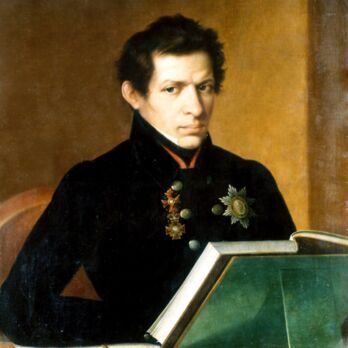
Nikolai Ivanovich Lobachevsky – a Russian mathematician, the creator of non-Euclidean geometry. Nikolai Ivanovich Lobachevsky was born on 20 November (1 December) 1792 in Nizhny Novgorod. In 1802 he entered the Kazan Gymnasium, which he successfully completed in 1806, demonstrating excellent knowledge in mathematics and foreign languages (French, German and Latin).
In 1807 Lobachevsky became a student at Kazan University, and in 1811 he graduated with a master's degree in physics. His main contribution to science is associated with rethinking the parallel postulate in geometry. He considered it too restrictive and proposed an alternative formulation: "through a point not on a given line, there may pass many lines parallel to the given line."
In 1826 Lobachevsky publicly presented his discovery, and later published a series of scientific works on the subject. His achievements in mathematics went beyond non-Euclidean geometry. Independently of J. Dandelin he developed a method for the approximate solution of equations and contributed to mathematical analysis, proving a number of theorems on trigonometric series. Lobachevsky also developed a criterion for the convergence of series and a definition of a continuous function. Nikolai Ivanovich Lobachevsky died on 12 (24) February 1856 and was buried at the Arskoye Cemetery in Kazan.
A service for finding museums across Russia, on a map, as a list, and in curated collections
Sign up
You have successfully registered, a confirmation email has been sent to the email address you provided.
Продолжая использовать наш сайт, Вы соглашаетесь на обработку файлов cookie. Data is processed to provide our services and improve the quality of our website and services.