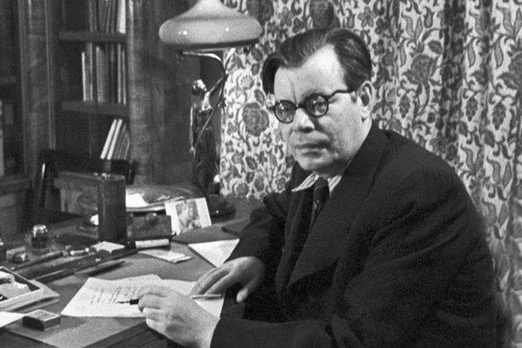
Mikhail Vasilyevich Isakovsky – a Soviet poet, prose writer, translator, and laureate of two Stalin Prizes of the first degree. He was born on 7 (19) January 1900 in the village of Glotovka in the Smolensk Governorate into a peasant family. After two years of schooling, Isakovsky briefly attended a gymnasium but was forced to leave his studies due to poverty. He was largely self-taught and published his first poem, "A Soldier's Request," in 1914. To help his family, Isakovsky became a teacher. In 1918 he joined the Russian Communist Party (Bolsheviks) (RCP(b)) and took part in revolutionary events and public life: he held the posts of secretary of the volost (rural district) Soviet and editor of the local newspaper. From 1921 to 1930 he worked for the Smolensk newspaper "Rabochiy Put" ("Worker's Path"), and in 1931 he moved to Moscow.
In 1927 Isakovsky's first collection of poems, "Wires in the Straw," was published and received high praise from Maxim Gorky. Many of his poems became popular "folk" songs — "Katyusha," "The Lonely Accordion," "Kuban Cossacks," and others. In his later years the poet devoted much time to translating works by foreign authors. Mikhail Vasilyevich Isakovsky died on 20 July 1973.
A service for finding museums across Russia, on a map, as a list, and in curated collections
Sign up
You have successfully registered, a confirmation email has been sent to the email address you provided.
Продолжая использовать наш сайт, Вы соглашаетесь на обработку файлов cookie. Data is processed to provide our services and improve the quality of our website and services.