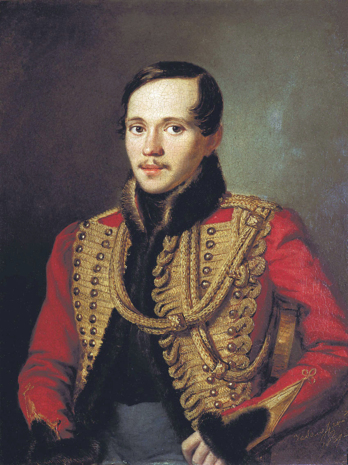
Mikhail Yuryevich Lermontov was a Russian poet, prose writer and playwright. He spent his childhood in the Penza province, at his grandmother's estate — that of the wealthy landowner Elizaveta Arsenyeva. The poet's mother died early, and his father was removed from his upbringing. Elizaveta Arsenyeva was a contradictory woman: a sharp mind and energy combined with strictness and authoritarianism, and she devoted all her efforts to raising her grandson. The young Lermontov knew languages, played musical instruments, painted, was an excellent chess player, and showed aptitude for mathematics. Lermontov's literary talent appeared already in his teenage years. He grew up wilful, spoiled, and withdrawn, and liked to spend time alone.
Lermontov graduated from the School of Guard Ensigns. Two years of barracks discipline, including a ban on reading fiction, were a severe trial for him. After finishing the school Lermontov entered service in a hussar regiment and gained the long-awaited freedom. High society life and service inspired his creativity: during this period he wrote "Vadim", "Masquerade", "Boyarin Orsha", "Khadzhi-Arbek", and the iconic poem "Borodino" — a reworked version of a youthful poem for the 25th anniversary of the Battle of Borodino. Pushkin's death was a deep personal tragedy for Lermontov. His poem "The Death of the Poet", filled with anger and sorrow, brought him wide fame and provoked the authorities' wrath.
Arrest and imprisonment did not break the poet — in prison, using soot, he created the immortal lines of "The Prisoner", "The Prayer" and "Desire." Thanks to the family's influential friends, Lermontov avoided harsh punishment and was exiled to the Nizhny Novgorod Regiment in the Caucasus. The first exile proved relatively mild. Upon returning to Petersburg he resumed social life and wrote "The Demon" and "Mtsyri." The second exile represented an uncompromising confrontation with the realities of military action. Service in the Caucasus tempered his character, and comrades noted Lermontov's fearlessness. This period was marked by the creation of the poem "Valerik" and the completion of the novel "A Hero of Our Time."
Lermontov's personal life was brief and marked by three significant but unhappy loves. The first, a youthful love for Ekaterina Sushkova, ended unrequited. The second, a mutual love for Varvara Lopukhina, did not gain the parents' blessing. The final intense feeling for Natalya, the daughter of a dramatist, also ended in rejection and inspired Lermontov to write some 30 poems dedicated to this "cold goddess."
After the second exile Lermontov sought solitude and literary work. However, under pressure from his grandmother, who insisted on a military career, he went again to the Caucasus in 1841. This trip proved fateful. In Pyatigorsk, after a trivial quarrel with retired Major Martynov that ended in a duel, Lermontov was mortally wounded. The poet was buried in the family vault in Tarkhany. Mikhail Lermontov left a rich literary legacy and is one of the most significant poets and prose writers of Russian literature.
A service for finding museums across Russia, on a map, as a list, and in curated collections
Sign up
You have successfully registered, a confirmation email has been sent to the email address you provided.
Продолжая использовать наш сайт, Вы соглашаетесь на обработку файлов cookie. Data is processed to provide our services and improve the quality of our website and services.