Sign up
You have successfully registered, a confirmation email has been sent to the email address you provided.

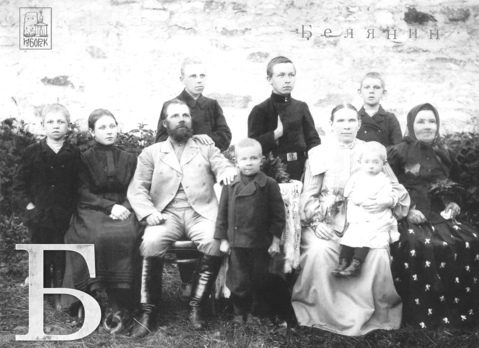
Mikhail Semyonovich Belyanin – a merchant. Belyanin came from a dynasty of second-guild merchants who owned gypsum quarries, an alabaster factory and were engaged in the flax trade. According to Belyanin's great-granddaughter, Natalia Sergeevna Belyanina, Mikhail Semyonovich was an adopted son. His biological mother, an innkeeper at a roadside tavern near Izborsk, died young. In infancy, Mikhail, together with her other children, was brought to Pechory, where orphaned children were left at the monastery. The merchant Belyanin, who had come to Pechory from Izborsk, took the boy into his family.
The merchant had his own sons, but aptitude for commercial affairs was most manifested by his adopted son, Mikhail Semyonovich, and therefore it was to him that the shop was bequeathed, while the other sons received land and money. Mikhail Semyonovich managed to multiply his capital, and later engaged not only in trade and agriculture, but also invested funds in the gypsum factory.
Mikhail Semyonovich and his wife Pelageya Georgievna had six sons: Alexander, Ivan, Mikhail, Nikolai, Grigory, Vasily and their only daughter Natalia. The Belyanins were educated and cultured people who treated one another and those around them warmly and respectfully. According to the great-granddaughter, this was the legacy they received from Mikhail Semyonovich Belyanin. In December 1917, Mikhail Semyonovich was forced to sell his house to the Cultural and Educational Society for 6,000 rubles, of which he took only 3,000 rubles and donated the remaining three thousand to the society. For his family he built a new house on Pskov Street in Izborsk. The first floor was used as commercial premises (a tearoom) and a warehouse. The second floor housed living rooms. Today Belyanin's house is part of the State Museum-Reserve "Izborsk".