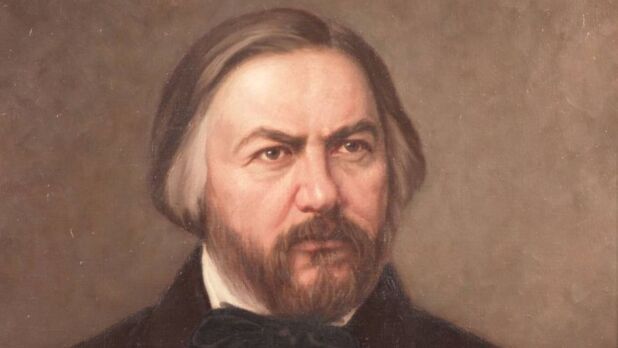
Mikhail Ivanovich Glinka was an outstanding Russian composer, the founder of the national classical music tradition. Glinka was born on the family estate Novospasskoye in the Smolensk Governorate and spent his early years raised by his grandmother. At the age of ten he began studying piano and violin. In 1817 the family moved to Saint Petersburg, where Mikhail enrolled in the Noble Boarding School attached to the Main Pedagogical Institute, and his mentor became the poet and Decembrist Wilhelm Küchelbecker.
In 1822–1823 Glinka composed a number of popular romances and songs: 'Do not tempt me without need' (lyrics by E. A. Baratynsky) and 'Do not sing, beauty, in my presence' (lyrics by A. S. Pushkin). During this period he associated with notable cultural figures such as Vasily Zhukovsky and Alexander Griboyedov. From 1830 to 1834 Glinka traveled through Europe, visiting Italy, Austria and Germany, studying European musical traditions and honing his craft.
After returning to Russia, the composer enthusiastically worked on the opera 'Ivan Susanin', the premiere of which took place at the Bolshoi Theatre in Saint Petersburg in 1836. Despite the opera's success, criticism prompted Glinka to leave again. He lived in France and Spain and returned to his homeland only in 1847. From 1851 he taught vocal music in Saint Petersburg, prepared operas, and had a significant influence on the formation of Russian classical music. Glinka died on 15 February 1857 in Berlin and was buried in the Lutheran Trinity Cemetery. His remains were later reinterred in Saint Petersburg.
A service for finding museums across Russia, on a map, as a list, and in curated collections
Sign up
You have successfully registered, a confirmation email has been sent to the email address you provided.
Продолжая использовать наш сайт, Вы соглашаетесь на обработку файлов cookie. Data is processed to provide our services and improve the quality of our website and services.