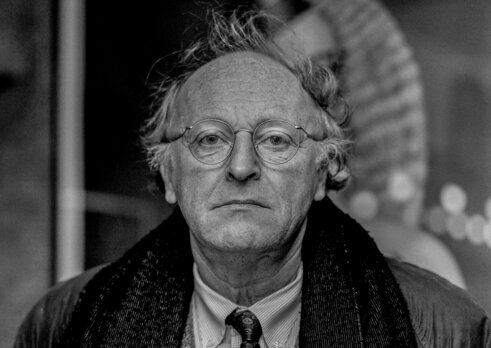
Joseph Alexandrovich Brodsky - a Russian and American poet, essayist, playwright, translator and educator. Laureate of the 1987 Nobel Prize in Literature 'for an all-embracing authorship, imbued with clarity of thought and poetic intensity'. Brodsky's early childhood fell during the years of the Great Patriotic War, the Siege of Leningrad and postwar poverty. In 1942, after the winter of the blockade, he evacuated with his mother to Cherepovets, returning to Leningrad in 1944.
After the end of the war Brodsky began to work. In 1955 he left school and took a job as an apprentice milling-machine operator at the 'Arsenal' factory. Later he worked as an assistant to a prosector, a stoker and a photographer. For a time he took part in geological expeditions, during one of which he discovered a small uranium deposit in the Far East. He wrote his first poem, by his own account, at the age of 18, and his first publication appeared in 1962.
In 1960 Brodsky was arrested for the first time but was soon released. In 1963 he began to be persecuted for his dissident views, and in 1964 he was arrested for 'parasitism' (being a social parasite). After a heart attack he was sent for compulsory treatment to a psychiatric hospital. In 1972 Brodsky was offered emigration and was forced to accept. On 6 June 1972 he was deprived of his Soviet citizenship and left for Vienna. In exile Brodsky worked at the University of Michigan, wrote and published actively, and associated with well-known cultural figures such as Stephen Spender, Seamus Heaney and Robert Lowell. In 1979 he obtained American citizenship and continued his teaching activities. In 1987 Brodsky was awarded the Nobel Prize. Joseph Alexandrovich Brodsky died in New York in 1996 and was temporarily buried there; in 1997 he was reburied at the San Michele cemetery in Venice.
A service for finding museums across Russia, on a map, as a list, and in curated collections
Sign up
You have successfully registered, a confirmation email has been sent to the email address you provided.
Продолжая использовать наш сайт, Вы соглашаетесь на обработку файлов cookie. Data is processed to provide our services and improve the quality of our website and services.