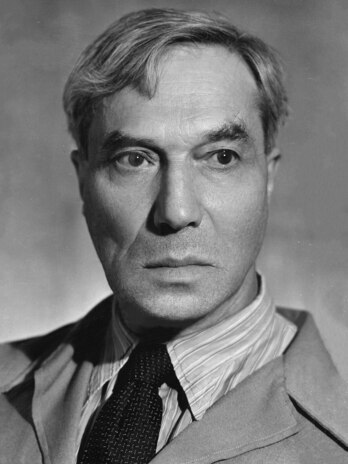
Boris Leonidovich Pasternak was a Russian Soviet poet, writer and translator. Pasternak was born into a family of intellectuals: his father was an academic painter and his mother a pianist, so the future poet grew up in a creative atmosphere. Prominent cultural figures visited the Pasternak home: Tolstoy, Polenov, Levitan, and Rachmaninoff and Scriabin performed at private concerts; the latter had a particularly strong influence on the young Boris — Pasternak devoted six years to music and even composed several works.
At the age of ten Boris first encountered discrimination because of his Jewish origin, which forced him to postpone entry to the gymnasium by a year. At twelve Pasternak suffered a serious leg injury which, in the poet's view, awakened his latent creative abilities. After graduating from the gymnasium with a gold medal (but without a certificate in Religious Studies), Pasternak prepared to enter the Moscow Conservatory. Despite his musical successes, he doubted his talent as a composer and was troubled by his lack of absolute pitch. In the end Pasternak abandoned a musical career and turned to poetry.
Pasternak enrolled at Moscow University in the Faculty of Law, then transferred to the Faculty of History and Philology, and later continued his studies at the University of Marburg. After returning from Germany, Pasternak devoted himself to literature, befriended well-known writers including Vladimir Mayakovsky, but maintained a neutral position regarding revolutionary events. After the revolution the poet's family remained in Germany. Pasternak kept in touch with relatives and Russian émigrés through active correspondence.
Pasternak's literary debut was marked by the publication of a poem in the anthology "Lyric." Around the same time his first independent collection "Twin in the Clouds" was published. In subsequent years collections such as "Over the Barriers," "Themes and Variations," and "The High Sickness," as well as the poetic novel "Spektorsky" and the autobiographical "Protective Letter" appeared. A trip to Georgia inspired the cycle "Waves," and the war years were reflected in his poems and essays dedicated to the liberation of Oryol.
In the late 1950s the writer was awarded the Nobel Prize for the novel "Doctor Zhivago." The Soviet authorities interpreted this as recognition of the writer's "anti-Soviet" stance. Figures such as Jawaharlal Nehru, Albert Camus and other prominent contemporaries tried to defend Pasternak, but this did not help: Pasternak was subjected to bitter harassment and persecution by the state and part of the literary community, was forced to decline the prize and signed a "repentance letter." After a series of shocks related to the novel, Pasternak lived only two more years. The poet was buried in Moscow, at the Peredelkino Cemetery.
A service for finding museums across Russia, on a map, as a list, and in curated collections
Sign up
You have successfully registered, a confirmation email has been sent to the email address you provided.
Продолжая использовать наш сайт, Вы соглашаетесь на обработку файлов cookie. Data is processed to provide our services and improve the quality of our website and services.