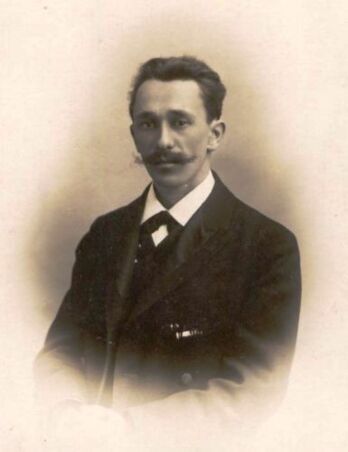
Andrei Vladimirovich Zhuravsky – a Russian scientist and researcher of the European North of Russia. He was born on 22 September 1882 in the city of Yelizavetgrad in the Kherson Governorate. After finishing gymnasium, from 1901 to 1906 Andrei Zhuravsky attended the course of natural sciences at the Faculty of Physics and Mathematics of the Imperial Saint Petersburg University.
Zhuravsky is the author of more than 400 scientific works covering a wide range of disciplines: biogeography, botany, agriculture, geology, entomology, ethnography and the region's economy. In 1905 he was awarded the Przhevalsky Medal by the Russian Geographical Society. In 1911, on the basis of the natural-history station and under his leadership, an experimental agricultural station was opened, demonstrating the possibility of developing agriculture in the Pechora region. The station's achievements were recognized with a gold medal at the Tsarskoye Selo exhibition.
Zhuravsky organized and led more than 20 expeditions to study the Russian North. He studied the geological structure of the Bolshezemelskaya Tundra, refuted the theory that the tundra was advancing on the forests, and proposed his own hypothesis of tundra retreat and climate warming. Among his discoveries was the identification of eleven Stone Age sites in the Bolshezemelskaya Tundra. In 1914, at the age of 32, Zhuravsky was killed by a gunshot fired by one of his employees on the doorstep of the natural-history station building in Ust-Tsilma.
A service for finding museums across Russia, on a map, as a list, and in curated collections
Sign up
You have successfully registered, a confirmation email has been sent to the email address you provided.
Продолжая использовать наш сайт, Вы соглашаетесь на обработку файлов cookie. Data is processed to provide our services and improve the quality of our website and services.