Sign up
You have successfully registered, a confirmation email has been sent to the email address you provided.

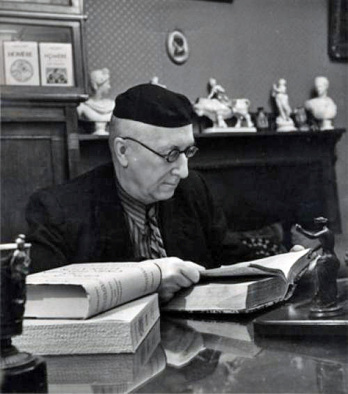
Aleksei Fyodorovich Losev (10 (23) September 1893, Novocherkassk – 24 May 1988, Moscow) – a Russian philosopher, philologist and writer. In 1911 he graduated from the Novocherkassk Classical Gymnasium with a gold medal and from the music school of the Italian violinist F. Staggi. In 1915 he graduated from Moscow University in two faculties at once – philosophy and classical philology.
He worked as a teacher in Moscow gymnasiums while preparing for his master's exams, which he successfully passed in 1917. For about three years he taught classical philology at Nizhny Novgorod University, where he was elected professor in 1919. In the 1920s he was a professor at the Moscow Conservatory and a full member of the State Academy of Artistic Sciences. In 1930 Losev and his wife were arrested and sentenced to ten years in labor camps in a fabricated case concerning the so-called Church Monarchist Center "True Orthodox Church". In 1933, due to disability and intensive labor in completing the construction of the Belomorkanal (White Sea–Baltic Canal), he was released.
In 1943, on the basis of his body of work, he was awarded the degree of Doctor of Philological Sciences. From 1944 until the end of his life Aleksei Fyodorovich taught at the Moscow Pedagogical Institute. From 1953 the publication of Losev's works resumed, primarily on the history of ancient culture. Losev's major life work was "History of Ancient Aesthetics", six volumes of which were published during his lifetime and earned him the State Prize (1986). Losev wrote about 100 articles for the five-volume "Philosophical Encyclopedia" (1960–1970). He was fluent in German, French and English, and read Italian, Polish and Czech. He was awarded the Order of the Red Banner of Labour (1983) and was a laureate of the USSR State Prize (1986).