Sign up
You have successfully registered, a confirmation email has been sent to the email address you provided.

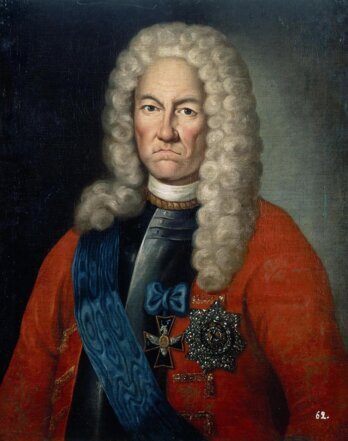
Yakov Vilimovich Bruce (1669–1735) – a Russian statesman, military officer, diplomat, engineer and scientist, one of the closest associates of Peter I. He was born in Moscow (according to other sources – in Pskov) into a noble Scottish family. He received an excellent home education and from an early age showed an interest in mathematics and the natural sciences, which he pursued throughout his life.
Having begun his service in the tsar’s poteshny (mock) troops, he took part in the Azov campaign. From 1689 he was a constant companion of Peter I, under whose orders he carried out various scientific works, translated scientific writings, and worked on compiling geographical maps, including a map of the starry sky. Peter I sent him to the Netherlands and England to complete his education. In 1699, at Peter I’s direction, he organized a “navigation school” – an educational institution where mathematics, astronomy and physics were taught. From 1702 the school was located in the Sukharev Tower, where Bruce equipped an astronomical observatory.
In 1700 Bruce received the rank of Major General of Artillery and, as head of the artillery, was with the army during the early years of the Great Northern War. He took part in battles and was repeatedly rewarded by Peter I and awarded orders. In 1717 he became a senator and president of the Berg and Manufactory Collegium. From 1706 Bruce oversaw the Moscow civil printing house, which printed the first calendar in Russia known as the “Bruce’s Calendar.” In 1721 he was elevated to the noble rank of count. After Peter I’s death, in 1726 Bruce submitted a petition for retirement, and he received the rank of field marshal. He spent the remainder of his life at the Glinki estate near Moscow, devoting himself entirely to scientific pursuits. He died childless and was buried in Moscow’s German Quarter. Before his death Yakov Vilimovich bequeathed his extensive library and a cabinet of various scientific instruments, as well as assorted curiosities, to the Kunstkamera of the Academy of Sciences.