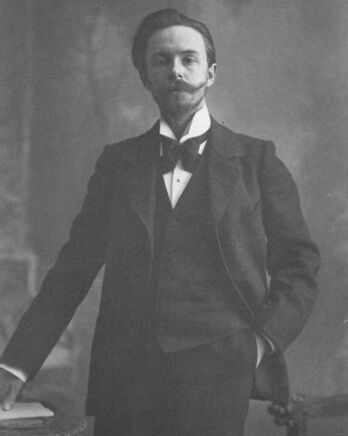
Alexander Nikolayevich Scriabin was a Russian composer, pianist and teacher. He was born on January 6, 1872 in Moscow into a diplomat's family. In 1882 he entered the Moscow Cadet Corps, studying music at the same time under the guidance of his mother, who was a pianist. After graduating from the corps in 1889, Scriabin enrolled at the Moscow Conservatory in two departments at once: composition and piano.
After completing his studies in 1892, Scriabin went on foreign tours and for five years gave concerts throughout Europe. Returning to Russia, he obtained the position of professor of piano at the Moscow Conservatory, which he held from 1898 to 1903.
In his compositional work Scriabin initially favored piano music. For the piano he created 10 sonatas, 29 poems, 26 etudes, 90 preludes, and others.
In 1900 Scriabin turned to symphonic music, setting both compositional and philosophical tasks for himself. The most significant symphonic works of this period were "The Poem of Ecstasy" (1907) and "Prometheus" ("The Poem of Fire", 1910). Scriabin was an innovator, the first to present a synthesis of music and light. The composer confirmed the existence of "colored hearing" and strove to unite all the arts. Scriabin died suddenly on April 27, 1915 in Moscow from blood poisoning caused by an accidental scratch. He was buried at the Novodevichy Cemetery in Moscow.
A service for finding museums across Russia, on a map, as a list, and in curated collections
Sign up
You have successfully registered, a confirmation email has been sent to the email address you provided.
Продолжая использовать наш сайт, Вы соглашаетесь на обработку файлов cookie. Data is processed to provide our services and improve the quality of our website and services.