Sign up
You have successfully registered, a confirmation email has been sent to the email address you provided.

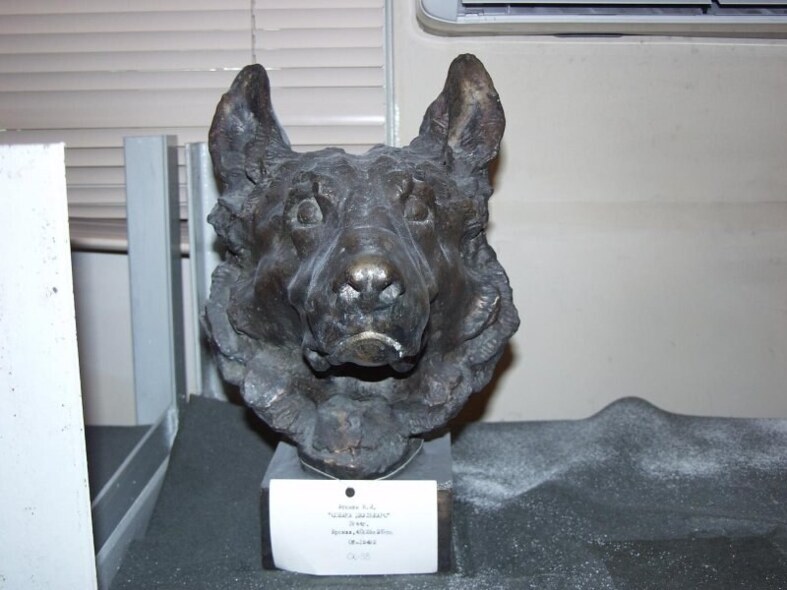
Nikolai Atyunin modelled this bronze head of a service dog, probably in 1944, in Sevastopol, which had just been liberated. While the sculptor worked, the dog's handler stayed close by the whole time and the dog never took its eyes off him; it is this moment that the bronze captures. The work is known as a portrait of Dzhulbars, but the museum notes that the identification of the dog is only an assumption.
Dzhulbars, an East European Shepherd of the mine-detection service, served in the 14th Assault Engineer-Sapper Brigade and cleared mines in Romania, Hungary, Austria, Czechoslovakia and other countries. According to the museum, on 21 March 1945 he was awarded the medal "For Battle Merit", and in May 1945 he was badly wounded while clearing mines at the grave of Taras Shevchenko in Kaniv. At the Victory Parade on 24 June 1945 the wounded Dzhulbars was carried across Red Square by the country's chief dog handler, A. P. Mazover, on a military tunic adapted into a kind of tray.
Nikolai Ivanovich Atyunin (1920–2006) served during the war as an engine mechanic in naval aviation, with the rank of sergeant, and in 1946–1951 studied at the Moscow Institute of Applied and Decorative Arts. The head is cast in bronze and measures 40 × 25 × 38 cm; the dog's ears are alertly pricked.
